Walking Together


The greatest outcome from sharing my story with the world has been the opportunity to help others. Since I finally opened up about my condition four years ago, my life has taken a turn for the better. Through writing and speaking about my patient story, I’ve had many wonderful people come into my life, from high school classmates I’ve reconnected with to complete strangers who were moved to contact me in some way. I am not terribly comfortable as the center of attention, but I do it because I believe that I am part of something much larger than myself.

To be honest, I don’t consider my story to be more inspirational than anyone else’s. I’ve said that many times before. Have I dealt with a lot? Absolutely, and I won’t sell myself short there. But at the same time, I am not the only one who has persevered in this world. I don’t have the market for inspiration covered, as I know of countless others who have dealt with even greater burdens. They are the people I turn to when I need to be picked up after a tough day.

Rather, what sharing my journey has shown me is that there is a great unmet need in society for impactful stories. Everyone these days is struggling with something, and far too many suffer silently. They walk the lonely road that I stumbled down years ago. People need to be reminded that they are strong enough to get through whatever it is that gets them down, and the best way to accomplish this is to hear the stories of others. People need to hear the good and the bad, the successes and failures. Meaningful, authentic stories connect with people on an emotional level like no other story can.

The need is great. I don’t say that as an exaggeration or as an indictment on society; it’s my observation from firsthand experience. Everyone is struggling with something. This is a favorite phrase of mine. My disease has (thankfully) made me more empathetic, to the point where I can identify easily when someone is having a tough time. It is sort of like my sixth sense.

Lately I have been receiving around 1-2 emails and messages per month from complete strangers. They usually ask me for advice or thank me for sharing my story. I am flattered, sure, but more than anything I want to help each person. Sometimes I have answers, sometimes I don’t. But if I don’t, I try to at least steer them in the right direction. I don’t want anyone to encounter me and not have their situation improve in some way.

I’ve thought a lot recently about how I can help people on a greater scale. For everyone that reaches out to me, I wonder how many others read or hear my story but are hesitant to reach out. I wonder even more how many people out there would benefit from hearing anyone’s story, let alone my own.

I realize that I can do a better job of communicating on here what has helped me on my journey these last few years. As a result, I am going to write about, in a series of posts, various pieces of advice. Each post will cover a specific topic that I will briefly outline below. You can find these posts under my new column heading, “The Adversity Playbook”. My hope is that, for anyone who stumbles across my website, they can use my experience as a starting point on their journey. Bumpy roads don’t have to be lonely roads.

I am not an oracle who has all the answers. I have made my mistakes along the way, and there are some days I go against this very advice I am about to tell because I am tired, stubborn, and/or frustrated. In short, I’m human.

I make this list as a jumping off point. It is only meant to scratch the surface of what I hope to write about in future posts.

Without further ado:

  1. Don’t go at it alone!

I can’t emphasize this enough – life is not meant to be lived in isolation, especially when you are going through a tough time. It is natural to feel isolated when the world around you cannot relate to your situation, especially if it is a disease. But the sooner you recognize that you can’t go at it alone, and more importantly, that you are not supposed to go at it alone, it changes everything. I am living proof of that. I wouldn’t be where I am at today if I didn’t reach out to my family, friends and coworkers and humbly admit I couldn’t handle my situation anymore. I needed a helping hand, and I got hundreds of them in return.

Asking for help is not easy, but it is crucial. Trust me.


  1. Seek out others who are going through a similar ordeal

Another helpful piece of advice is to seek out others who are going through something similar to what you are dealing with. If you Google the issue – whether it’s a disease, a failure, a setback, whatever it is – you will undoubtedly find someone who has gone through it or who understands how you feel. It builds off the first point – community is essential. If you have a disease, rather than shut yourself in (which is the natural human reaction), seek out others who can understand what you are dealing with. Join a Facebook group, or an organization whose mission is to find a cure or provide services and support. It seems intuitive, but I know of many people who don’t do this, and it makes me sad.


  1. Don’t be afraid to fail

I am no longer afraid of failure, which is a good thing because I’ve encountered it over and over and over again, especially this year on my job search. I can stomach it because I have come to realize that anything worthwhile in life requires risk, and nothing worthwhile is given to you on the first try. If you fail 99 times out of 100, the one time that you succeed outshines the other 99 failures.

This notion has sustained me every time I fall. I am past the point where I can pick myself back up on my own. Every fall is a reminder that my body is failing me. But every time I end up back on my feet, and I take my first step on solid ground, I realize how worth it it is to get back up.


  1. Share your story!

When you get through the difficult times – and you will – share your story with others. When I finally opened up about my journey and wrote my first article – a piece for the Jain Foundation (whose mission is to find a cure for my disease) – a weight was lifted off my shoulders. Sharing your story will empower you and give you confidence, and just as importantly, it will help others. It doesn’t take much. Trust me, your story is not boring, and it will have an impact. Any small impact, even if it brings a smile to one person’s face, makes it worth it.

Keep in mind, the moment you overcome your difficulties, someone is experiencing that hardship for the very first time, and they don’t know where to turn. You can be that beacon of light for someone else, as only you can.

_________________________________________

If you have any questions about any topic on here, or anything that is not covered, please don’t hesitate to reach out to me, chrisanselmo@gmail.com.


Rare Disease Day

What a day.

Last Monday – February 29th – was Rare Disease Day around the world. The day exists to raise awareness about rare diseases and the urgent need for increased funding in order to bring about treatments. Just as important, the day celebrates patients like myself who are living with a rare disease, and helps to reinforce how we are part of a much larger community. According to Global Genes, there are approximately 350 million people around the world living with a rare disease, which shows that collectively, we are anything but rare!

I had the honor of speaking at the Massachusetts State House as part of their ceremony to commemorate Rare Disease Day. I was actually supposed to speak at this event last year, but, as I’m sure you all remember so fondly, it was a terrible, terrible winter. I simply could not make it downtown with all the snow on the ground. Fortunately I was invited back this year, and I gladly accepted. Even better, there was no snow to be found.

I had not been to the State House in many years, and had never been in the Great Room – a large, open room on the second floor with high ceilings and natural light shining through the roof. It was 65 and sunny out, so there was plenty of sunshine in the room, which set the mood for the uplifting ceremony.

I was the third of four patients to speak, after opening remarks from the emcee and a state representative. There were over 450 people registered for the event, and almost all of them showed up, as all the seats were full and the back area was standing-room only.

When I got up on stage I was a little nervous, but then I calmed down and started talking. I reminded myself that I had given this talk many times before. I could have used notes but decided not to. For some reason I am more comfortable when I memorize what I am going to say rather than referring to notes as signposts. Every time I watch a speaker look at notes I get distracted, so I try to not be that person, even though it is perfectly ok.

My speech turned out well, although I always feel like I can do better. I am a bit of a perfectionist. Afterwards, I was approached by several people in the audience who enjoyed hearing me speak, and wanted to connect after the event. Perfect speech or not, this why I do it. I enjoy using my story to help inspire others and to open new doors for myself that would not have opened otherwise.

The only downside to the day was that it was exhausting; I just don’t have a lot of energy anymore. I tired out quickly from standing and talking to people, then sitting down for long periods of time, then alternating sitting and standing as the photographer took pictures. I got home afterwards and took a nap, and ended up missing class.

Nonetheless, it was an exhilarating day. In addition to speaking, I also had an article published on STAT, which has been a goal of mine since it launched late last year. STAT is a life sciences website owned and operated by the Boston Globe. I am one of the first patients to be featured on the site, which is quite exciting. Hopefully there will be more opportunities for me to write for them in the future.

I heard from people from all parts of my life who liked and commented on the article, and who wished me well as I spoke at the ceremony. All in all, this was a day and an experience that I will never forget.

Here are some links to the pictures that were taken at the ceremony: 

https://www.massbio.org/events/signature-events/rare-disease-day-43537

https://www.facebook.com/media/set/?set=a.10154569351133448.1073741930.377893583447&type=3


Storyteller

One of the greatest benefits of business school, besides the education of course, has been my evolution as a public speaker. When I started the program almost a year and a half ago, I was terrified to stand in front of an audience. I was fearful that my voice would crack out of nervousness or my mind would go completely blank. It also doesn’t help that I can’t stand for long periods of time anymore. My first presentation in school went about as awful as you’d expect – my mind went blank and I had to read word for word off the slide. It was painful to watch.

Thankfully, for both the audience and for myself, things have changed dramatically. I not only have improved my presentation skills, but I also have caught the speaking bug. Although I still get nervous and would rather not present on business topics, I can hold my own in front of my classmates. Part of my improvement has been due to public speaking classes I’ve taken at school. I’ve learned techniques and tips that have been extremely helpful in structuring my presentation and in controlling my body language.

However, the greatest reason for my success has been outside of the classroom. The opportunities I have had to share my patient story is what has truly gotten me over “the hump”. I am at my most confident when I am sharing my story with others, and talking about my journey, specifically what it’s like to go from ability to disability. After all, who isn’t comfortable talking about themselves?

I mean that jokingly of course. The answer is me. I am not naturally someone who likes to be the center of attention, under a spotlight both literally and figuratively. The first time I spoke about my condition in front of an audience, I thought I was going to have a panic attack and throw up on stage. Now though, I can recite my story almost without thinking. What I realized is that my journey these last eight years is so ingrained in my soul that it is part of who I am. There is no memorization required; I just have to tell it like it is.

Over the last three years I have had wonderful opportunities to speak and share my story in front of various audiences. In April 2013 I was invited to the Jain Foundation conference in Washington D.C., where I talked about my experience with the disease and my participation in the clinical outcome study sponsored by the foundation. Thankfully I didn’t throw up on stage, especially since it was videotaped!

A year and a half later, in November 2014, I told my patient story at a fundraiser I helped organize called Strength, Science and Stories of Inspiration. That night was when I realized I was onto something special. There had to have been 200 people in the audience, including friends and my parents. Although nervous, I had control of the room from the start and it was a great success. More importantly, it made me realize that not only was it not that hard to share my story, but that my story was having an impact on people.

That belief was solidified a few weeks later, when I gave an “Eagle Talk” – the BC MBA program’s version of a TED talk. In front of 50-60 classmates and professors, I gave a 25-minute presentation that was extremely well-received. The talk also had the added benefit of finally putting me at ease with my classmates. I had been looking for a way to tell my friends what it was like to walk in my shoes, since this was the first time I had met a new group of people while disabled. Everyone else I knew – family, friends and coworkers – saw me transition from ability to disability. They knew me when I could run and climb stairs, only to see me weaken before their eyes over the next few years. This talk helped to put my life before business school into context for my new group of friends. I wanted them to know I was not always this way, but that I am also not ashamed of who I am.

I not only find it exhilarating to inspire an audience, I also like being able to tell my story on my own terms. When I speak, there is no editor, no filter between what I want to say and what is actually said. It is not written on paper for people to interpret or misinterpret. My story comes right from the source, and the audience can see the emotion and the vulnerability firsthand.

At the same time I believe, and make clear in my talks, that my story is not any more inspirational than the next person’s. I don’t have a monopoly on inspiration. There are countless people who are dealing with far worse hands and who are inspirations to me every day. Instead, I like to think of my speeches as helping to make others aware that any ordinary person has what it takes to overcome adversity and to fight through setbacks. If I can do it, anyone can. That is where I derive my greatest enjoyment, in helping others to realize this fact. I don’t share my story to have someone come away from it saying “Oh he’s so brave!“, as if it takes a great deal of courage to get up in the morning and try to live a semblance of a normal life despite my condition.

But I digress. Since that two-week stretch in November 2014, I have been looking for more opportunities to speak to a wider audience. I’ve given several presentations in class where I’ve been able to put my newfound confidence to work, but I’ve been yearning to go back to what has gotten me to this point – sharing my story and offering advice. It’s been over a year since I’ve given a talk, and I have to say I miss it a lot.

The speaking bug has also been gnawing at me this year as I search for a job. I keep asking myself, what do I really want to accomplish in my career? I realize now that whatever I do, speaking to crowds has to be a part of my life. Maybe I should be a public speaker – I’ve certainly considered it. It seemed inconceivable two years ago, but now it feels like a real possibility.

Over the past few months, in addition to class work and job hunting, I have been working hard to find opportunities to speak, which is why I am happy to say that more talks are in the works!

Without further ado, here is my schedule these next few months:

February 24th – I am so excited about this – I will be speaking to students at Northwest Catholic High School in my hometown of West Hartford, Connecticut. As part of their leadership curriculum, I will be sharing my story, and time permitting, sharing advice and the wisdom that I’ve accumulated over the last eight years. I’ve always wanted to convert my story into a talk where I can motivate and give others practical advice when dealing with adversity, and this is that opportunity!

February 29th – Five days later, I will speak at the Massachusetts State House for Rare Disease Day 2016. I was supposed to speak last year but the weather thwarted those plans. I am determined to be there this year, even if I have to sleep in the State House to do it. (On second thought, I am a bit of a germophobe so that may not be a good idea.)

March 24th – I will be on a panel at Northeastern, talking to students with disabilities about job hunting and the experience of declaring one’s disability in the job hunting process, something I have struggled with personally. I am hopeful and confident that I will be able to ease their concerns and show them that it can be done successfully, even if it is an added nuisance.

April 3rd – The third annual Strength, Science and Stories of Inspiration event will be held, location TBD. Although I will not be speaking this time (besides a short introduction), it is a great event that I hope you all can attend! More details to come once I know more….

May 29th – Still somewhat tentative, but I have been invited to speak at the Jain Foundation’s patient conference in Dallas. I’ve never been to Texas so this should be a fun time! It will be great to meet other patients with my disease. Any time you are dealing with something like a rare disease, it is imperative to meet others who are going through what you are dealing with on a daily basis. There is a level of unspoken understanding that is a huge comfort. The staff at the foundation are also wonderful people who I’ll be happy to see again!

So that’s it for now – I am open to other opportunities as they come about. As I’ve learned, oftentimes these opportunities pop up out of nowhere. It’s going to be a busy next few months, but at least it will be worthwhile. If any of them get videotaped I’ll be sure to share them!


History Lesson

This has certainly been an interesting time in my life. The last four months – heck, the last sixteen months – have been a complete blur. That is business school after all. That’s what everyone told me would happen. The last sixteen months have been a whirlwind of classes, exams, social events, and conferences. It has been full of sickness (thankfully not norovirus), weakness, laughter, stress, exhilaration and frustration. I even became a New Yorker for a summer.

Through it all, I have managed to stay afloat, although each semester it seems to get tougher. I remember back in September it was especially harrowing, so much so that I wondered how I would ever make it to winter break. Well, here I am – battered, bloodied, but otherwise unscathed.

When I was home for Thanksgiving I was almost through the madness, but faced another two weeks of final exams, papers and presentations. Thankfully, I still took some time to read for fun. I am a huge history buff, especially the Civil War. My mom brought down a few books I had on the subject that were collecting dust on a bookshelf. They provided a welcome escape.

One book was on the battle of Shiloh, one of the bloodiest battles of the Civil War. It was 350 pages, but I flew through the book in no time. It was fascinating to think that the Union army under Ulysses S. Grant could be caught so off-guard by the Rebels. The situation got so bad on the first day of battle that they were nearly driven into the Tennessee River and forced to surrender.

What Grant did next helped motivate me to think of my challenges in a new light. His army was routed on the first day, but it was not defeated. There is no question he shares a lot of the blame for being unprepared in the first place, but his reaction to his circumstances helped change the face of the battle, and ultimately the war. Instead of retreating across the Tennessee as his subordinates pleaded, he decided to fight back and surprise the enemy the next morning (it’s always an easier decision when you receive overnight reinforcements).

The Federals surprised the Confederates and drove them out of all the land they conquered the day before. By the end of Day 2, they had recovered all their lost camps. The cost? Over 23,000 casualties. The Battle of Shiloh was vicious, but it showed the power of keeping cool when everything is going wrong, and of taking bold risks when the situation dictates prudence.

Now, I would not equate what I am going through to war, not in the least. But it is a struggle. Reading about the battle, I almost felt like I was being pushed relentlessly back by adversity to the brink of failure. I had no choice but to respond. I needed to complete my classes. I needed to network and find a job. Failure is not an option for me. I had to push back, and thankfully I was able to. Now I am on break and can rest for a month, although the struggle is far from over.

That’s not to say the last four months have been all sour grapes. In fact, this period of turmoil has been instrumental in forcing me to think about what I really want to do in life. Not what types of jobs I should be getting with an MBA, but what I really want to do. A lot of the jobs posted I haven’t been able to get my heart into, even though they are great positions. Through my circumstances, I have come to learn and to appreciate that I am on the road less traveled, as Robert Frost would say. I have been given quite a unique hand in life. Thankfully it could be much worse, but my disease is an unrelenting nuisance.

Because this condition is so rare, oftentimes I feel like I am alone. I do my best to explain my situation to others, but I still feel like there is a disconnect that can only be bridged by having someone walk in my shoes, and I wouldn’t wish that upon anyone. The only compass I can rely on is the one inside of me. There is no blueprint for how I should live my life with this disease. Only anecdotes.

Although different, I have come to realize that although my circumstances have their disadvantages, they also have their advantages. My disease has lit a fire in me to make a difference in the world. I could easily see myself, without this disease, living a safe, comfortable life. I probably wouldn’t have even gone to grad school. There is nothing wrong with a safe, comfortable life – that is a blessing to have in this day and age. But there is something hard-wired into me that seeks a different life. It’s like I have this burning desire to do something no one else has done. I guess that makes me an entrepreneur, but I don’t feel like I am one in the traditional sense. At the end of the day I want to spend my time doing something that has a true, tangible impact on people’s lives, using my creativity to tell stories and better the lives of those who are in need of inspiration.

How this will manifest itself in my life I have no idea. Should I be a speaker? A writer? All/none of the above? I don’t know yet. I am letting the process play out while being proactive. I have my first speaking engagement in February. If it works out, it may lead to many more, and I may have my answer. Whatever the answer ultimately is, I will be comfortable with it. Long ago I stopped questioning my purpose in life, as the dots seem to be connecting every time I look back. I just have to be patient, and as I’ve said before, trust the journey will take me someplace worthwhile.

And hey, if the road gets bumpy, it never hurts to be reminded that when you are up against a river, you still have what it takes to fight your way back.

Keep Hope Alive

So apparently my last blog post was on September 1st. Today is October 2nd. Yikes. That’s right – I went a month (a month!) without writing a post. In my world, that might as well be 10 years.

For the last couple of weeks I could hear the clock ticking in my head to write something – anything. To go a month without a post is a great way for me to go insane. After all, writing is my outlet, just like exercise is to so many others. Today – finally – I found some time to write, and I already feel better.

September was a whirlwind of a month – much bumpier than expected. I thought the second year of business school would be easier than the first, but I was wrong. New classes, logistical challenges and a setback on the job front made for a rough last few weeks. Sleeping became difficult again, and my heartburn returned, although not as bad as it was this time last year.

Although I’ve been busy, the other reason it took so long to write this is because I wanted to wait until I was level-headed again. I don’t like ranting, and I don’t like writing in the heat of the moment. The internet has a long memory – the last thing I need is to say something I will regret later on. Twitter has been the downfall of many for this very reason.

I like to think that I am capable of handling adversity, but I am still prone to falling into an extended funk when things don’t go my way. This last month showed me I still have to get better at remaining calm. I am not a pleasant person to be around when I’m sulking.

Fortunately, adversity is a topic I’ve written extensively about these last few years, so all I had to do was go back and reread (at my mother’s urging) pieces I’ve written in the past. The best person to give advice to me is, apparently, my former self. Reading these older posts was a useful exercise in remembering just how far I’ve come. I was reminded of how difficult everything was for me a few years back, when I was first trying to come to grips with a weakening body and the loss of many abilities. It put into perspective the challenges I’ve faced in the last month, which, lets face it, are minor in comparison.

My challenges today are more existential than anything. Class isn’t overly difficult, and I’m free during the day, so it’s not like I am overwhelmed with tasks, outside of a few meetings here and there. I guess part of what I’m struggling with at the moment is figuring out where I fit in the world. I feel like I am holding a piece to a puzzle, only I can’t find the puzzle. I can’t figure out where I belong, but I also feel like that I am destined for something great. I don’t mean that in an arrogant way, but I feel like I am meant to go through all of this to help others. I feel like that is why I’ve suffered, and also why I am so willing to share my story.

Right now though, I don’t know what job that translates into. Should I get a real, MBA-level corporate job, or become a motivational speaker? Should I become a writer and write a memoir or a screenplay, or work at a pharmaceutical company? I don’t know the answer. Can I do everything? I wish, but I don’t have the energy to. I have to choose wisely. I also have to weigh monetary concerns – I have to make sure I’m earning an income when I graduate since loans will be breathing down my neck before I know it. I’m casting a wide net so I don’t constrain myself or turn away opportunities I may not have initially considered. I am open-minded, but with that mindset comes additional stress. I’m confident I can work, speak, and write simultaneously, but what mix of the three is appropriate? I’m not sure.

But, I’ve gotten through uncertainty before and I’ll get through it again. I’ll get through it because I have to. I’ve come too far – with continued persistence and a chip on my shoulder that has served me well to this point, I will become something. I just need to keep grinding and keep fighting. I didn’t come this far to give up now.

The Only Constant is Change

Just like that, it’s over.

My summer in New York was quite possibly the fastest ten weeks of my life. It seems like yesterday that I was pulling my hair out trying to find a place to live, scouring Craigslist and a host of other sites for an apartment that was accessible and that I could afford. That hunt took place back in May; now it’s August, and the summer is just about over. But what a summer it was.

Spending ten weeks as a finance intern at a Fortune 50 company is an intense, fast-paced experience. Pfizer is a company I had wanted to work at for a while. Over the course of the summer the MBA interns were given the opportunity to meet with executives at the company to learn about their careers and to engage them in Q&A. One of the highlights of my summer was getting to ask CEO Ian Read a question, which was a huge thrill. Additionally, the interns were assigned a case study that required talking to people all throughout the company in many different functions. It was a great way to meet employees we normally wouldn’t interact with, and learn about the industry in a way that we wouldn’t have been able to otherwise.

The Pfizer building on 42nd and 2nd – my home for ten weeks.

I didn’t intend to leave Boston for my summer internship, but looking back I am happy for the change of scenery. I will always love Boston, but sometimes you don’t know how much you love something (or someone) until you are away for a period of time. In New York I was able to catch up with friends I hadn’t seen in years – and in one case, since high school. Although I wasn’t able to walk around the city as I would have liked, it was still a rewarding experience to meet up with friends, even if I kept meeting up with everyone at the same bar around the corner from my apartment. I gave Tuttle’s a lot of business.

My time in New York was not without its frustrations. The first couple of weeks were extremely rough logistics-wise. Any time I am thrust into a new situation where I have to learn a new routine, it is a difficult transition for me. I got lost a lot inside the building, which added extra steps to my day and tired me out. My original desk was far away from the bathroom, my boss’s desk and the elevators. Fortunately my desk was moved and I was able to settle in and relax.

A building bordering Bryant Park.
The W.R. Grace building bordering Bryant Park.

On the other hand, I am happy that I was doing all this walking in a new environment, in a new city, with new streets and experiences. If I have to walk constantly, I might as well be exhausting myself somewhere new and exciting. As a whole, I walked a lot this summer, and its unclear what toll it will take on my body. I was sore and stiff for many days after I left, and it’s just now starting to subside, two weeks later. I am not sure if further weakness will replace the soreness, but given my past history, it probably will. I still feel wobbly walking down the street, which is a little unsettling.

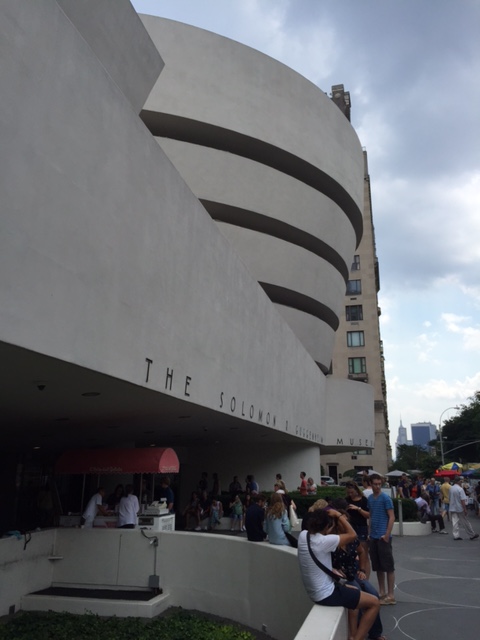
But, as I’ve written about countless times before, I have to get used to the uncertainty that my body throws at me every day. I have to be comfortable with the fact that doing something as simple as going to The Guggenheim now requires an hour of planning and costs much more now to experience (once you factor in the cab rides). This is how my life is, and I have no choice but to accept it. Fortunately, I’ve become a logistical expert through trial and error.

The Guggenheim.
The Guggenheim.

So, given how the summer played out, would I do it all over again? Absolutely.

I made many great friends in my ten weeks. I had a wonderful boss and was surrounded by supportive admins who never hesitated to ask how I was doing and if I needed anything. My friend and classmate Matt joined me at Pfizer this summer, often carrying my lunch on his tray. Many of the other finance interns showed the same willingness to help. We became a close-knit group, and will definitely keep in touch going forward into our second year of business school.

All in all it was a great time. I am back in Brookline now, relaxing before classes start back up on the 31st. I am confident that my experience has prepared me well for the future, which at the end of the day is all I could have asked for in an internship.

More importantly, I proved to myself that I can handle the challenge of living in New York City. It has chewed up and spit out many people, and for the first couple weeks, I was afraid that I would be one of them. Over time I adjusted, and I thrived. If this disease has shown me anything, it is that the toughness I am required to possess on a day-to-day basis just to function in this world makes the toughness and grit required to live in New York pale in comparison. I can handle this city just fine.

School starts in less than two weeks; life is moving at a tremendous speed. Change is constant in my life, whether it’s new classes, a new city, or my declining strength. Deep down I wonder what it would be like to have a stable, predictable life, but I am starting to believe I wouldn’t enjoy it. I can deal with the fast pace of life as long as I continue to find meaning in my struggle, and am surrounded by people I enjoy spending time with. My disease is a major source of aggravation, but it may very well be my path to living a greater life.

On to the next challenge: figuring out if I have it in me to root for BC football.

Go NU.


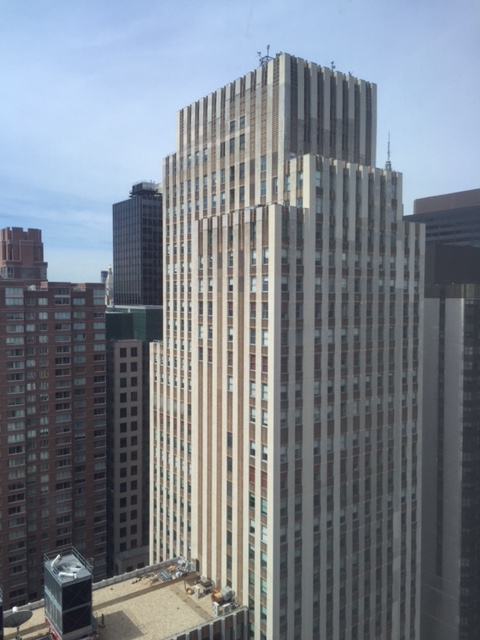
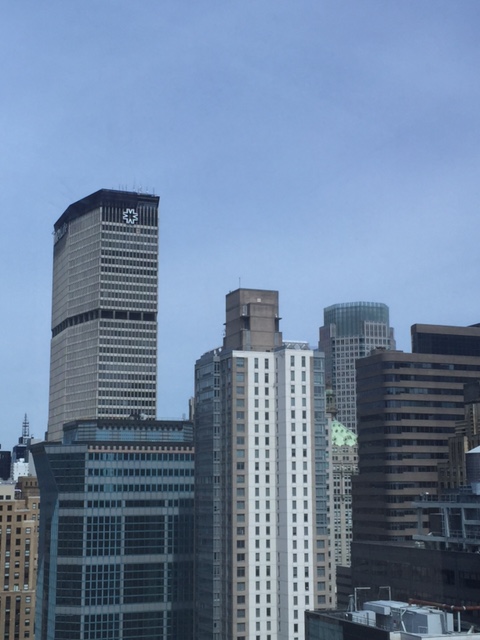
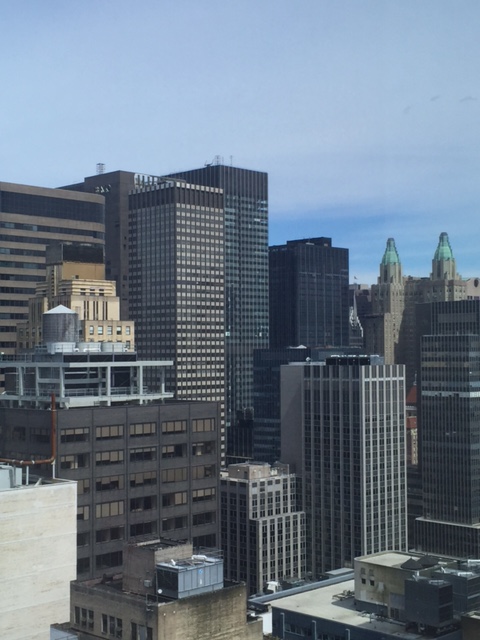
Some views from the 32nd floor of the Pfizer building:

View from the 32nd floor.

The Chrysler building, also from the 32nd floor.

IMG_0357

IMG_0359

One Step Backwards

Today I was at a restaurant that had one step to enter. This normally isn’t an issue for me, however the step was a considerable height, high enough where I needed someone to help lift me under the armpits in order to get in the door.

In my opinion, one step is more infuriating than a full staircase. Although I don’t like that older buildings do not have to abide by the Americans with Disabilities Act and retrofit in order to accommodate people with disabilities, I am a reasonable person. I understand that a building that is old cannot put in an elevator or even a steep ramp. The ADA is meant to provide accommodations within reason. It still frustrates me, but I get that old buildings cannot be made accessible, unless someone invents an elaborate pulley system. That’s a topic for another day.

But one step? Come on. Most buildings that have one step to enter could easily put in a ramp, or even keep a portable ramp as a short-term solution. One step is infuriating. Why not make it level with the street? Why not have a ramp to begin with instead of a step? It isn’t impossible to reconfigure the step into a ramp, and it can be done without ruining the aesthetics of the property.

Instead, the step becomes a barrier. I am lucky that I can still go up a step, even with help. I don’t know how much longer that will be the case though. One step might as well be a giant brick wall to people who are in wheelchairs or scooters. The step basically tells these people that they aren’t welcome, or shows that the owner doesn’t care enough to make their establishment accessible for everyone. It isn’t too much of an exaggeration to call it a form of discrimination. Unfortunately, many people don’t realize this.

On one hand, we live in a society that is more accepting and “equal” than ever before. A lot has changed in the last few years. On the other hand, when the issues facing people with disabilities come to the forefront, people don’t realize that there is still a long way to go. The challenges that stem from a society built for the able-bodied aren’t insurmountable, but they add frustrations that are completely unnecessary, and often insulting. A single step as a barricade to enter a restaurant is just that – insulting.

This isn’t an indictment on everyone in society, because people do care when they are made aware of it. When I had to exit my classroom building last year through the trash room because the facilities department blocked off the only accessible exit in order to remove snow, that angered a lot of my classmates, mainly because they never had to think in these terms before. I used to be the same way, so I can’t rant too hard without turning into a hypocrite. When I was younger and wasn’t disabled, I never thought about these types of challenges. I never thought twice about walking up a step to enter a restaurant. It’s just not something that is ingrained in the minds of the general public.

Now that I’m on the other side of ability, this is all I think about. I am not a natural-born squeaky wheel, but I guess it’s time to put on my advocacy hat.

Trusting the Journey

I still can’t believe I ended up in New York.

When my internship hunt began last fall I wanted to stay in the Boston area, where I am comfortable and where I feel safe. Boston is familiar; it is a constant. It is an anchor in my otherwise change-filled, stormy existence. As a result, I never seriously entertained the thought of moving to another city for a job, especially a city as large as New York. I have nothing against the Big Apple, however it takes a special person to thrive amidst the hustle and bustle. New York is not for the faint of heart – it is big and fast and uncompromising. It is the type of place that will eat you up and spit you out if you aren’t careful. You have to keep your head on a swivel and your focus sharp otherwise you will get overwhelmed by its unrelenting pace. Some people thrive in New York; others wilt under the pressure.

I distinctly remember having trouble adjusting years ago when I visited the city, a time when I was far more mobile. Every time I’d come down to visit I’d end up with a massive headache, whether it was from the adrenaline rush or from sensual overload. I never felt comfortable in New York. Fast forward to last November. New York was still not a credible option. Even if I found a job in the city, I thought, the logistics would be a nightmare, or at the very least a hassle I didn’t need to endure. Fate apparently had other ideas. One night at the last moment I decided to attend a company information session, and came away impressed. I felt I had nothing to lose in applying. Next thing I know I was booking a train down to New York in the dead of winter. Shortly thereafter, I was given an offer I couldn’t refuse.

So naturally, where am I writing this from? New York. As I’ve learned by now, life doesn’t follow a script. It’s funny how it all played out. I remember telling myself at each stage of the interview process that I wasn’t going to go through with it, but a voice deep within kept telling me it was a risk worth taking. Every time I wanted to stop the process and withdraw my name from consideration, I said yes when I was convinced I was going to say no. At the end of the day, it was the right opportunity, at the right company, at the right time in my life. This chance may never come along again. The hourglass of my mobility is slowly, steadily, draining towards empty. If I didn’t move to New York now, would I ever get this chance again, while I can still walk on my own two feet?

IMG_0234
When you can’t walk the streets, find a rooftop.

I am three weeks in, and am happy to report that I have acclimated myself quite well. Thanks to the support of my parents and my fellow BC’er who I’m interning with, the logistics have worked. I am happy with my decision, especially since it is only for a summer and it provides a perfect test run of the city and of the job. I have adjusted about as well as I can reasonably expect. However, the adjustment has not been without frustration. When is it ever?

I used to love walking down streets and getting lost in my surroundings. New York has some of the most beautiful architecture in the world and a variety of neighborhoods with varying degrees of grit and charm. Each street is famous and unique in its own way. Going for walks was always a favorite activity of mine. Exploring neighborhoods always added context to my life. To have my ability to walk slowly taken from me, as you can imagine, has been excruciating. I don’t mind not being able to run and I can live without climbing stairs, but walking freely has been the toughest ability to lose. Since New York is so big and so many of the subway stops are only accessible by stairs, I have to be driven everywhere. I can’t tell you how many buildings I’ve passed by that I want to see in greater detail, or restaurants I want to wander into and eat everything on the menu.

In Boston I have been able to distract myself from what I’ve lost by focusing on schoolwork and spending my time with friends. I know which places I can go to and which to avoid due to inaccessibility. Here in New York, it has been quite the learning curve. It has taken me a while to build up comfort with the city, and believe that there are actually places I can go to that are accessible. Right now whenever I hear about a cool place I check Google Street View and Yelp, only to find out more often than not that I can’t get in. This year marks the 25th anniversary of the Americans with Disabilities Act, yet I still often feel like an afterthought in an able-bodied society that values “historic preservation” over inclusion. I can’t even imagine what it was like 25 years ago.

But none of this is new to me, nor is it unexpected. The most difficult adjustment has been in answering questions about my disability. Since I am in a new city, in a new place of employment, I am surrounded constantly by new people. Inevitably, I am getting a lot of questions such as “Did you injure yourself?” or “What happened to your leg?” as I fill up my cup of water or while I’m being driven to work. Some people have asked where I live, and when I tell them it’s only three blocks away, they say “Oh nice, it’s not a bad walk then.” For that answer, it’s best to nod.

It’s not a fun spot to be in. On one hand, when someone asks about my crutches I could say “Actually, it’s not an injury, I am disabled” and watch as the person’s face contorts in horror. On the other hand, I could outright lie and say “I injured my back”. I don’t like either extreme, so the best answer is usually somewhere in between; a half-truth if you will. “Yeah, I’m having leg problems” or something like that. The fewer words the better. Usually when they realize you are not willing to talk about it they drop the subject. When they ask where I live and assume I can walk three blocks, I know they mean nothing by it.

These questions hurt. They force me to have to answer about why I am different (my crutches and how I walk), yet deep down I know that the person is sincere and wants to feel empathy for me, so I have to answer respectfully. If I answer “Yeah, I can walk it under extreme duress”, they become humiliated, I become humiliated, and no one leaves that conversation feeling good about themselves.

This is why I like to tell everyone – especially if I am in a new group of people – as soon as possible about my condition. Although I don’t like bringing it up, it’s like pulling off a band-aid: it is better to get the pain over with as soon as possible.

You are probably thinking by now that I’m having a terrible time down here, but I assure you that is not the case. Improbably, despite these bumps in the road – and that’s what they are, small speed bumps in the grand scheme of things – I have adapted to my surroundings. You see, a city like New York shows you quickly what you are made of. Although I’ve encountered the inevitable ups and downs, there is nothing this city can throw at me that can compare to what I’ve been through.

New York has thrown me out of my comfort zone, but then again I can’t remember the last time I was in my comfort zone. Playing it safe won’t get me to where I want to be. At this point in my life, I have come to believe that there is something greater at work, and I have to let it play out. The dots are connecting. Whether I am actually on the journey towards the cure for my disease, or I have merely tricked myself into believing it, I don’t know.

But what I do know is that I am not satisfied. Until I can say that I can walk those three blocks home without lying through my teeth, until I can say yes to going somewhere without dwelling about accessibility, until my body doesn’t feel like a prison anymore, I will not be satisfied. I will put up with every disappointment, every frustration, every question, every societal injustice I have to if it makes it worthwhile in the end.

I still can’t believe I ended up in New York. Then again, I’m right where I need to be.

IMG_0259
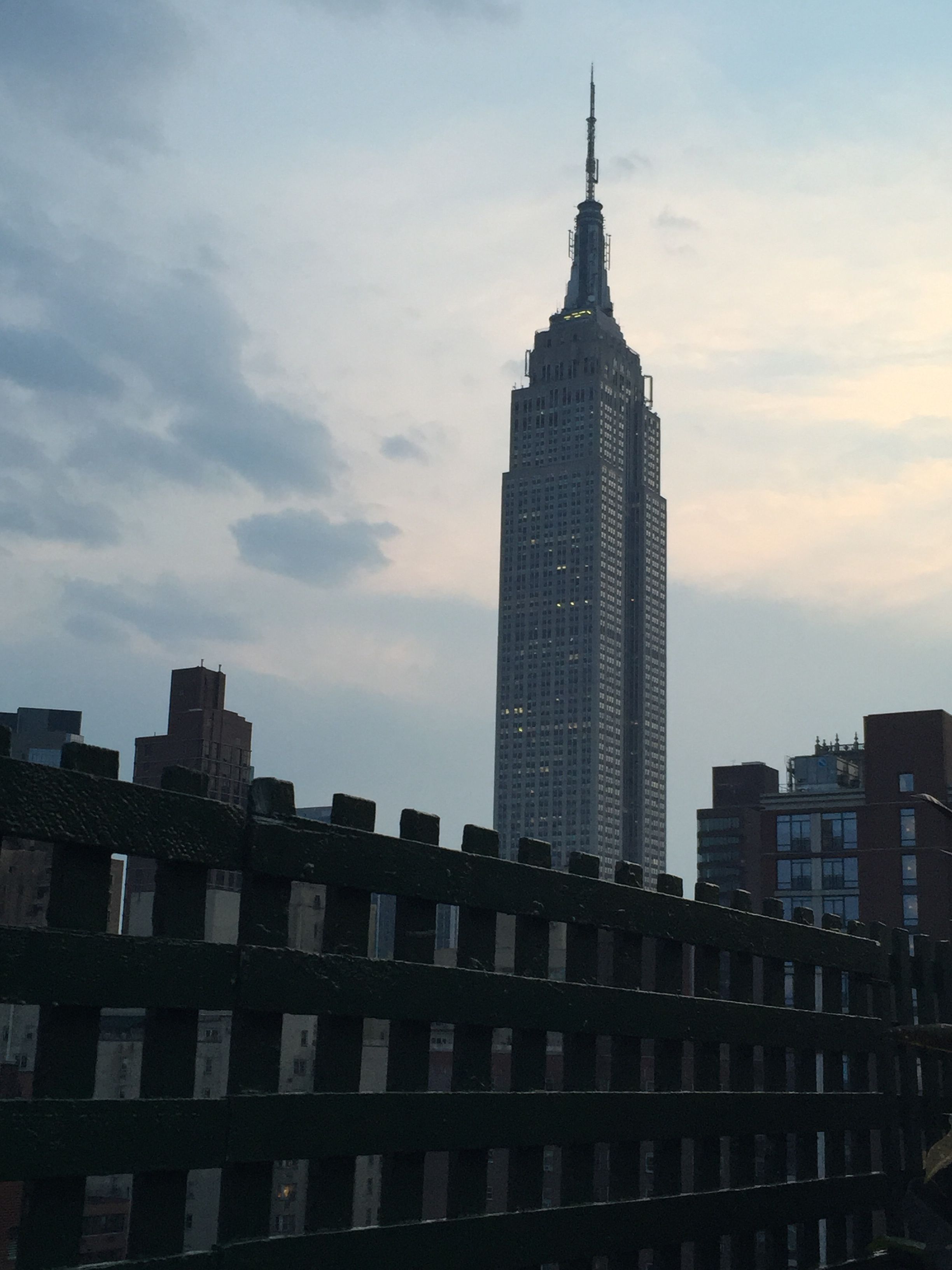
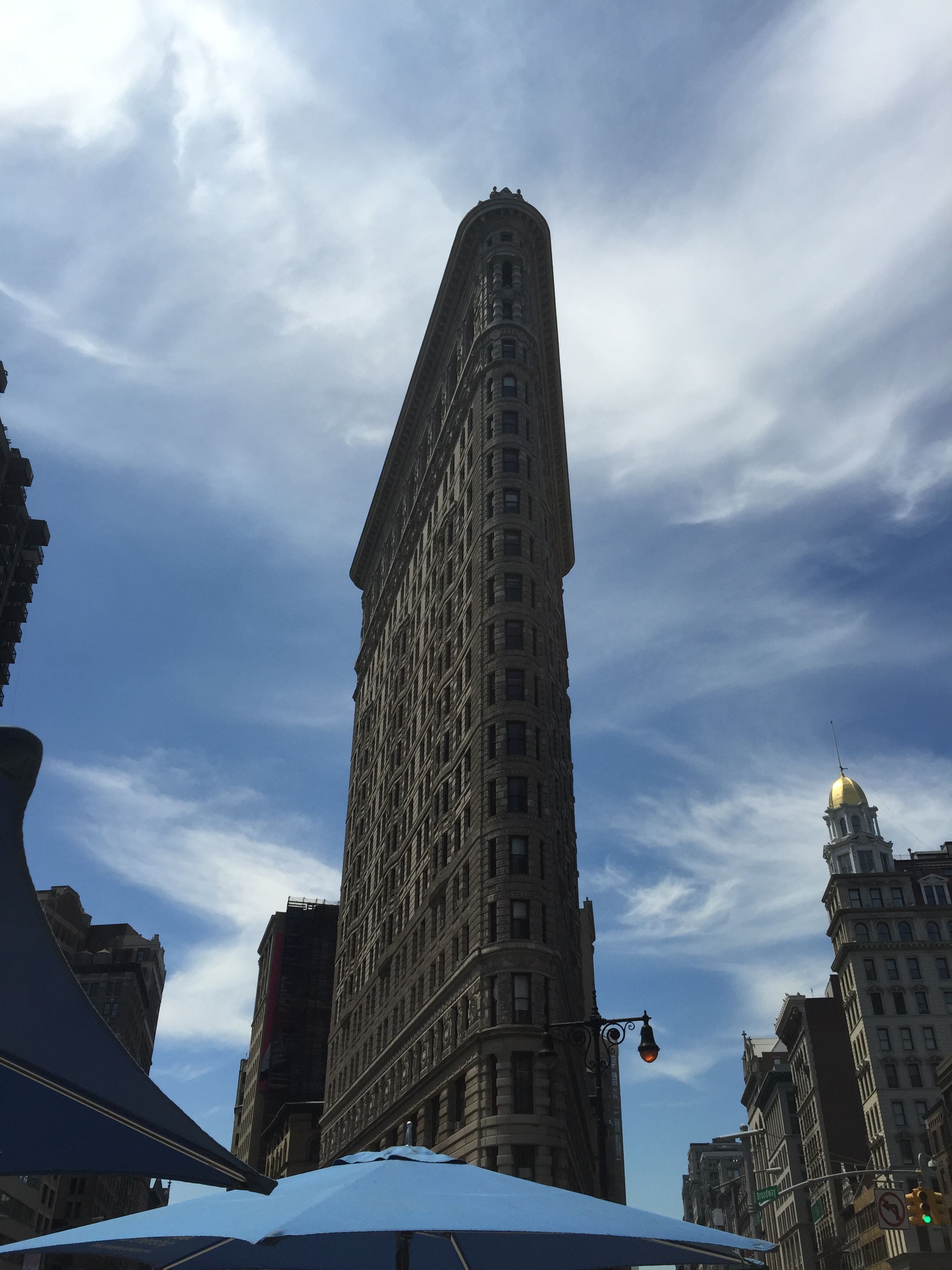
My favorite building in New York, the Flatiron building.

A Week in North Carolina

Back when I was a member of the working world and had an actual income, I would try to visit my sister as often as possible at her home in North Carolina. It was only a two-hour flight from Boston to Charlotte, so it made for a convenient weekend trip. When my niece Sophia was born two years ago, there was added incentive to come down and visit. If it was possible to come down once a month, I would.

It is such a different world down here. The people are friendlier and the pace is slower. Sweet tea and biscuits are the norm. North Carolina, and the South in general, is different than Boston in almost every way, both good and bad. For my sanity I have found it important to get out of Boston every once in a while, to experience this more relaxed, deliberate way of living.

Now that I am back in school it has become more difficult to visit. The only reason I am down here now is because I have a scheduled doctor’s appointment tomorrow. The appointment is part of a clinical outcome study that monitors the progression of my muscle condition. Thankfully one of the testing sites is in Charlotte, and it gives me a convenient excuse to visit the area and combine the trip with seeing family.

Charlotte has quickly become a home away from home. My sister and her now-husband moved down here a few years ago from Washington D.C., right after I graduated from college and around when I started experiencing symptoms. I remember helping them move to their apartment overlooking Lake Norman. I carried heavy boxes up three flights of stairs without much of a problem. It seems like a lifetime ago. It has been a humbling decline, but through it all, my excitement for being down here has never wavered. It is just so relaxing.

Could I live down here full-time? Probably not. My future is too ingrained in the Northeast and I value having everything I need within a short radius. The rest of my family lives in Connecticut and I value being close to them as well. Down here, whether you are in Charlotte proper or in the countryside (especially if you are in the country), you have to drive everywhere. The gas station, the supermarket, the restaurants – they are all spread out. I like to be able to walk outside my apartment and have five different food options, two bars, a CVS and a grocery store all within a couple blocks, and know that there are several more in every direction.

IMG_0195
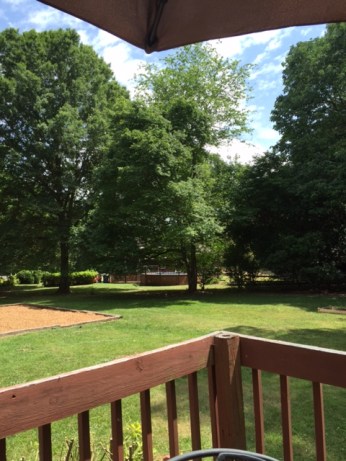
May weather is perfect – come August, not so much.

Then again, there are views like this one right outside the door. To the city-dweller, this is something called grass. And those tall things in the distance are trees. The only open space in Boston can be found in parks. Of course, with this open space comes mosquitoes, bees, stray cats, and somewhere in this county, a black bear (according to the news).

I admit the food down here is not the healthiest, but it sure is tasty. The skylines of most towns are dotted with tall signs for every chain restaurant you can think of: McDonald’s and Burger King for sure, but also Zaxby’s, Bob Evans, Hardee’s, Steak ‘n Shake, Cook-Out, and my favorite, Bojangles. You can’t beat their chicken strips, mashed potatoes and mac and cheese, along with their sweet tea and biscuits. I’m not a huge sweet tea fan. Every time I drink it I feel like my teeth are about to collectively fall out. Which actually brings up a quick point of caution: if you order tea down here, they give you sweet tea by default. That’s almost as bad as Dunkin’ Donuts putting cream and sugar into a “regular” coffee.

This post isn’t meant to be a comparison of whether North Carolina or Boston is better; instead I like to think of them as perfect complements. North Carolina could not be more different from Boston, and that is quite ok.

Once I am back in the working world, and once this clinical outcome study is over with for good (I have one more year), it will be nice to come down here and visit for the sake of visiting. It will be nice to spend time with my sister’s family without thinking in the back of my mind about an impending appointment, which, although it serves an important purpose in collecting data necessary for future clinical trials, reminds me of how far I’ve declined.

As I get ready to leave now and head into Charlotte, I can’t help but think about how next time I visit,  my sister’s home will be a family of four, not of three. In October I will have a new nephew to play with. I will find a way to make it down here, escaping the obligations of my life up north, if only for a weekend.

As his Boston-based uncle, I have to ensure that he grows up a Red Sox fan.

Marathon

My school year ended late last Wednesday in the atrium of Fulton Hall, when the finalists were announced for the Diane Weiss Consulting Competition. Only three out of twenty teams were selected for the finals, and my team was not one of them. Although it would have been nice to take part in this prestigious event, I was relieved that my first year was officially over. No more exams. No more presentations. No more late nights editing PowerPoint slides and writing reports. Just like that, I was free to do anything I wanted.

I could sleep in.

I could nap.

I could have a midday, mid-week beer and not think twice.

It was a great feeling to be finished. When I returned to campus to watch the finals on Thursday, I saw the collective relief on the faces of my classmates. Many had come straight from the golf course; others from somewhere else outdoors.

We were done. We survived.

Looking back on these last eight months, my first thought was of how fast it all went by. I remember my first day of orientation like it was yesterday – I showed up on my scooter, knew no one, and worried what people might think to see someone using crutches. Would I be judged by my peers before they had a chance to know me as a person?

Fortunately, these worries proved hollow. I would not have gotten through these last eight months without building a solid group of friends. In a small program such as the MBA program at BC, you get to know everyone quickly, and are in the same classes with the same people all year long. Repetition builds familiarity, familiarity builds friendship, and friendship builds comfort. The first year of business school is a nonstop mental grind, so any comfort is cherished.

The year flew by like a sprint, but in many ways it was also a marathon. Unlike undergrad where classes took place over the course of a semester, this year I had new classes every seven weeks. A semester’s worth of material is crammed into each quarter, which can make it tough to keep your head above water. If you miss a class, you fall behind; there’s no way around it. The amount of homework and reading was unlike anything I’ve ever experienced before. I signed up for this, but it was still tough.

I was in a constant state of stress. My sleep schedule was completely thrown off. My eating habits reverted back to my time at Northeastern. I was warned by those who have gone to business school that it would be a difficult transition, even for the able-bodied. They were absolutely right. For someone like myself who is already low-energy, it meant that physically I was out of whack the entire year. I can already feel a difference and I haven’t been done a week. The stress has melted off. I am sleeping better, eating better, and overall, feeling better. Although I wouldn’t change the decision I made, during the heat of the struggle I did find myself asking whyWhy put myself through this physical and mental stress? Every time I arrived at the same answer: the reward will be worth the pain.

It’s interesting how we as humans willingly put ourselves through prolonged periods of stress for the hope of some better payoff in the long run. We deny ourselves enjoyment in the short-term, investing hours and hours of hard work and stress in order to say that we achieved a major goal. We hate every minute of the torture, the pain, and the sacrifice. We always complain to ourselves (and to others) that the ends can’t possibly justify the means. But they always do.

There is no better example of this than a marathon. My marathon happened to be business school, but for others it is the actual 26.2 mile journey. Just a few short weeks back was the Boston Marathon, which took place on a rainy, windy day. Although the conditions were less than ideal for watching, it was perfect for runners. Thousands of runners run the marathon every year, cheered on by over half a million spectators. No matter the weather conditions, it is always an amazing day. Some runners run competitively, while many others running for causes near and dear to their hearts. Four of my classmates ran the Boston Marathon, representing causes from the American Liver Foundation to the Dana-Farber Cancer Center.

This year, I happened to be someone’s running cause. Through a friend, I was lucky enough to have gotten involved with Genzyme’s Running for Rare Diseases program, which matches an employee at Genzyme with a patient with a rare disease. My runner was Sara Cole, about as nice of a person as you can find. She ran the Providence Half Marathon on my behalf on May 3rd. It’s never ideal to have a condition that someone is running to help cure, but on the bright side, it proves that there are many wonderful people out there in the world.

I often think about what it would be like to run a marathon. Maybe someday I’ll regain all my muscle strength and will be able to withstand the endurance training to find out. That would be funny because growing up, I hated running. Hated it. It would always make me nauseous and I was never good at it. We’d have to run all around the Hall High School field, and every time I would walk to the finish line. It was miserable. My back would always end up hurting because, well, things were going on in my body I wasn’t aware of at the time.

I would do anything to have the chance to run again. I wish I could be the one doing the running vs. being the person that someone is running for, but I am still extremely grateful.

In the meantime, I must focus on the mental marathons. It feels good to sleep in, but like any good marathoner, after the rest comes preparation for another. One year is down, but I still have an internship, a second year of school, and the rest of my life ahead of me. There is still much to accomplish.